KEYNOTE ADDRESS
SECURITY GOVERNANCE AND GLOBAL DYNAMICS: RETHINKING SECURITY, INSTITUTIONS AND THE FUTURE OF PEACE
Delivered by
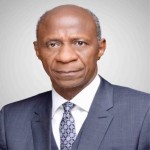
Kayode Adeolu Egbetokun, Ph.D, NPM, fspsp
Inspector-General of Police, Rtd.
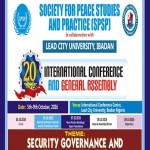
At the 20th International Conference and General Assembly of the Society for Peace Studies and Practice (SPSP)
Theme: “Security Governance and Global Dynamics”
International Conference Centre, Lead City University, Ibadan
5th–9th October, 2026
PROTOCOL
The President of the Society for Peace Studies and Practice, Professor Benjamin Adeniran Aluko, fspsp;
The Special Guest of Honour;
The Guest of Honour;
The Founder and distinguished members of the Society for Peace Studies and Practice;
The Vice-Chancellor and distinguished members of the Management of Lead City University, Ibadan;
Distinguished scholars and members of the academic community;
Heads and representatives of security, intelligence and law-enforcement institutions;
Senior government officials and policymakers;
Members of the diplomatic community;
Distinguished practitioners, researchers and peacebuilders;
Members of the media;
Ladies and gentlemen
I am deeply honoured to have been invited to deliver the keynote address at this important conference. But for me, this is more than an invitation; it is a homecoming. I am a Fellow of this Society, and I have attended this conference in years past not as the keynote speaker, but as a member of this distinguished body.
So, standing here today as the key note speaker carries a significance that is deeply personal to me. And I say with conviction that some of the members seated here today will in future edition of this conference be celebrated as the key note speakers or even as the Special Guest of Honor.
1. For over three decades, I stood on the frontline of security practice in this country. I have seen security from the vantage point of command, operations, policy and leadership. Yet today, I stand before you also as a student of peace.
2. That journey has taught me one enduring lesson: peace is not simply the outcome of security; peace is one of its pillars. We may build institutions, strengthen intelligence, deploy personnel and develop sophisticated security architecture, but where peace cannot be sustained, security itself cannot endure.
3.This is the 20th edition of this conference. Twenty editions of a conference devoted to peace and security represent more than institutional longevity. They represent two decades of sustained intellectual engagement with some of the most consequential questions facing our societies: how conflict emerges, how insecurity spreads, how institutions respond, and how peace can be made durable.
4.I therefore commend the leadership and membership of the Society for Peace Studies and Practice for sustaining this important platform.
5.The theme of this year’s conference, “Security Governance and Global Dynamics,” is both timely and profoundly relevant, reflecting the complex realities of our world and the urgent need to rethink how we understand, govern and sustain security in an increasingly uncertain global environment. Security is no longer shaped exclusively by what happens within national borders or by what traditional security institutions are able to control.
6.A financial transaction can cross several jurisdictions in seconds. A cyber attack can cross the world in a second. A criminal network can recruit through a digital platform from another continent. A local dispute can acquire regional consequences. A conflict in one region can disrupt energy and food market thousands of kilometers away. A technological innovation developed for legitimate purposes can be adapted almost immediately for criminal use. Events that once appeared geographically distant can now produce consequences much closer to home. Disinformation can undermine public trust with a single post on a social media platform.
7.The world has therefore become more connected, but connectivity has brought both opportunity and vulnerability. The same systems that enable commerce, communication and development can also be exploited to facilitate crime, violence, fraud and instability. Artificial intelligence is creating new opportunities for economic development while simultaneously introducing new challenges for national and international security.
8.The central question, therefore, is no longer simply: “How do we protect the state?” It is: “How do we govern security in a world where risks are interconnected, power is distributed, and no country can manage the major threats of our time alone?” That, I believe, is the defining security question of the twenty-first century.
THE GLOBAL DYNAMICS SHAPING OUR LOCAL INSECURITY
9.Ladies and gentlemen, no country today faces a purely local security problem. The dynamics are global, that is what I capture as the
Globalization of disorder.
Terrorism, banditry, cybercrime, arms trafficking, drug trafficking, and illicit financial flows are not Nigerian problems. They are global networks with local franchises in Nigeria. The AK-47 recovered from a forest in Zamfara was likely manufactured in Eastern Europe, trafficked through Libya, financed with ransom from kidnapping, and facilitated by a compromised border. Our local insecurity is a supply chain.
FROM NATIONAL SECURITY TO NETWORKED SECURITY
10.Ladies and gentlemen, we are witnessing a transition from national security to networked security. The state remains indispensable. Sovereignty remains important. Armed forces, intelligence institutions, diplomacy and law enforcement remain essential. But none of them can operate effectively in isolation.
11.Consider the contemporary security environment. A nation’s critical infrastructure may depend upon foreign technology. Its energy security may depend upon international markets. Its food security may depend upon global supply chains. Its financial stability may depend upon decisions taken in distant capitals. Its information environment may be shaped by platforms operating beyond its jurisdiction.
12.This means that security governance must increasingly become multilevel, multidimensional and multinational. It requires governments to work with international organisations, regional institutions, the private sector, universities, civil society and communities. The security architecture of the future must be built through partnerships and institutions capable of managing interdependence.
TECHNOLOGY AND THE NEW SECURITY FRONTIER
13.Perhaps nowhere is the transformation of security more visible than in technology. Artificial intelligence, autonomous systems, quantum technologies, biotechnology and cyber capabilities are changing both the nature of power and the speed at which threats emerge.
14.The challenge is not to stop technological progress. That would neither be realistic nor desirable. The challenge is to ensure that innovation is accompanied by governance.
15.We need rules that answer difficult questions. Who is accountable when an autonomous system causes harm? How do we protect critical infrastructure from increasingly sophisticated cyberattacks? How do we prevent artificial intelligence from becoming an amplifier of disinformation? How do we protect democratic institutions while preserving legitimate freedom of expression? And how do we ensure that technological power does not become concentrated in ways that undermine international stability?
16.These are not merely technical questions. They are political, ethical, legal and security questions. The countries that succeed in the coming decades will not necessarily be those that possess the most advanced technologies. They will increasingly be those that develop the best institutions for governing those technologies.
HUMAN SECURITY MUST REMAIN AT THE CENTRE
17.There is, however, a danger in discussing security exclusively in terms of states, weapons and technology. We must remember the individual. Governments may speak about national security. International organisations may speak about strategic stability. But ordinary people experience security very differently.
18.For a family, security means having food. It means being able to live without fear. It means access to healthcare. It means employment and economic opportunity. It means protection from violence. It means knowing that institutions will treat citizens fairly.
19.This is why human security must remain a pillar of national security. secure states with insecure citizens are not truly secure.
20.We must move from State Security to Human Security.
Globally, National Security Strategy must be defined around the daily security need of the citizen: food security, job security, health security, school security. A hungry, unemployed youth is a recruitment base for any extremist ideology. Policing poverty with bullets is a losing strategy.
21.A global security system that protects borders while ignoring poverty, displacement, climate vulnerability and social exclusion will remain fundamentally incomplete.
22.Distinguished colleagues, perhaps the greatest challenge we face is not the absence of knowledge. We know many of the risks. The problem is the gap between the emergence of threats and our ability to respond collectively.
23.Technology evolves faster than regulation. Crises develop faster than diplomatic processes. Information travels faster than institutions can verify it. Global problems increasingly transcend national jurisdictions.
24.We therefore need to rethink the architecture of international security governance. We need institutions that are: more representative, more responsive, more transparent and more capable of acting collectively.
25.We must reform the governance of security, not just the equipment of security.
I led the Nigeria Police Force. I know the dedication of our officers. But I also know the structural deficits. We need to unbundle policing. A single federal police structure for 230 million people is ungovernable. We need a constitutionally defined multi-level policing system — federal, state, and community — with clear rules of engagement, funding, and accountability. We must however approach devolution of policing powers to the states and local communities with caution. Security governance means clarity of roles. We must support the government to achieve this.
26.We must build a security knowledge economy. One thing I know the Society for Peace Studies and Practice do very well is to bridge theory and practice. Our security agencies are rich in experience but not so in documentation. We need research centres within our police colleges, military institutions, and security agencies. We need after-action reviews, data analytics, and evidence-based policing.
27.We must govern the cyberspace and information domain. We need a national framework for information integrity. The same way we govern our airspace, we must govern our information space against disinformation, hate speech, and extremist propaganda, while protecting free speech. This is the new frontier of internal security.
28.We must strengthen regional and global partnerships. No country can handle transnational crime alone.
29.My dear colleagues, I have served at the highest level of security in this country. I have seen the maps, the threat assessments, the body bags. And I can tell you with all humility: there is no military solution to a governance problem. All institutions must work together, the private sector must play their roles, public trust must be treated as security infrastructure, the information space must be governed like we govern the air space, citizens must cooperate with the government.
Security is not what is provided alone by government, it must be produced by the Society.
30.Security without peace is temporary. Peace without governance is illusory.
TOWARDS A NEW MODEL OF SECURITY GOVERNANCE
31.Distinguished ladies and gentlemen, our discussion points towards a security governance model built on several connected principles.
32.First, prevention and resilience must receive greater emphasis. Intelligence, early warning, community engagement and institutional preparedness should be treated as investments.
33.Second, we must strengthen institutional capacity and continuity. Sustainable security cannot depend excessively on individual personalities. Leadership matters, but institutions must possess processes and standards capable of surviving changes in leadership.
34.Third, intelligence and evidence must drive decision-making. The challenge is not simply to collect more information, but to convert information into reliable intelligence and intelligence into sound action.
35.Fourth, we must strengthen coordination and partnership. Institutional boundaries should not become barriers to addressing threats that themselves operate across boundaries.
36.Fifth, we must embrace technology responsibly. Innovation should strengthen security while remaining subject to law, ethics and appropriate oversight.
37.Finally, security governance must remain anchored in human dignity and public legitimacy. The ultimate purpose of security is not the preservation of institutions for their own sake. It is the protection of people and the creation of conditions in which society can live, work and develop in peace.
CLOSING CHARGE: GOVERNING THE FUTURE
38.Distinguished ladies and gentlemen, the central lesson of our discussion is straightforward: contemporary security is no longer simply about responding to threats. It is about governing the conditions in which threats emerge, spread and are contained.
39.The security environment is becoming more interconnected, technologically enabled and transnational. Our institutions must therefore become more capable of seeing connections rather than isolated incidents, anticipating risks rather than merely reacting to them, and working across institutional boundaries rather than within them.
40.For Nigeria, this requires a security architecture in which government, security institutions, communities, academia, the private sector and international partners each contribute according to their responsibilities and expertise.
41.It also requires us to recognise that security cannot be separated from justice, development, institutional legitimacy and public confidence. A society is not secure simply because threats are being confronted. It is secure when its institutions are capable of protecting people while retaining their trust.
42.As we mark the twentieth edition of this conference, therefore, our responsibility is not simply to reflect on what has been achieved. It is to prepare institutions for what is coming next.
43.We cannot predict every technological development, criminal innovation, demographic change or geopolitical shift. But we can build institutions capable of adapting when those changes arrive.
44.That is the essence of strategic security governance: to build institutions that can anticipate without pretending to predict, respond without abandoning principle, innovate without sacrificing accountability, and exercise authority without losing legitimacy.
45.Let this conference therefore strengthen the connection between scholarship and practice. Let evidence inform policy. Let experience inform research. Let communities be treated as partners in prevention while also cooperating with Government Institutions. And let security institutions remain committed to professionalism, accountability and public trust.
46.Ultimately, the measure of a secure society is not the size of its security institutions. It is the confidence with which its citizens live, work, raise their families, pursue their ambitions and participate in public life.
47.The future will not judge us only by the threats we inherited. It will judge us by the institutions we built to confront them and the values we preserved while doing so. That is the responsibility of security governance. And that is the opportunity before us.
CONCLUSION
48.I thank the Society for Peace Studies and Practice for the honour of this invitation and congratulate the Society on the 20th International Conference and General Assembly.
49.I wish the Society many more years of impactful scholarship, policy engagement and practical contribution to the advancement of peace and security.
50.May the scholarship generated through this platform continue to influence policy; may the partnerships developed here strengthen institutional capacity; and may our pursuit of security remain firmly anchored in justice, human dignity, the rule of law and respect for fundamental rights.
51.Above all, may we never lose sight of the ultimate purpose of security: to create the conditions in which people can live without fear, communities can prosper without violence, and nations can pursue development in peace and stability.
52.God bless the Society for Peace Studies and Practice. God bless Lead City University, Ibadan. God bless the Federal Republic of Nigeria. May peace, security, justice and human dignity prevail in Nigeria, across Africa and throughout our world. Thank you.